Article at a glance
Why this matters: ServiceNow SAM is most valuable when license, entitlement, usage, renewal, cloud, and SaaS signals are connected to decisions. The article should help readers move from inventory visibility to cost, risk, and compliance action.
How to apply this guidance
| Step | What to clarify |
|---|---|
| 1. Confirm evidence | Validate entitlement, usage, deployment, renewal, owner, and cost evidence before making compliance or savings decisions. |
| 2. Create action paths | Turn findings into reclamation, renewal, audit, rationalization, and approval workflows. |
| 3. Measure outcomes | Track compliance position, reclaimed licenses, avoided spend, renewal risk, and cycle time for remediation. |
Use the rest of the article as a planning checklist: confirm the target outcome, test the workflow and data assumptions, then connect governance, ownership, measurement, and adoption before expanding the use case.
ServiceNow Software Asset Management, or SAM, helps organizations understand what software they own, what is installed, what is being used, and where cost or compliance risk exists.
For beginners, SAM can feel complex because software licensing is full of publisher terms, entitlements, subscriptions, installations, usage data, and audit risk. ServiceNow SAM brings those pieces into one workflow-driven view so IT, finance, procurement, and compliance teams can make better decisions.
What SAM means in plain language
SAM is the discipline of managing software from request and purchase through deployment, usage, renewal, optimization, and retirement. It helps answer practical questions: Are we compliant? Are we overpaying? Which licenses are unused? Which renewals need attention? Which software can be reclaimed or rationalized?
Why this matters now
Software spend continues to rise because of SaaS growth, cloud subscriptions, remote work, and decentralized buying. At the same time, publishers still expect accurate compliance evidence. SAM helps reduce waste while lowering audit and true-up surprises.
Core concepts to understand
| Concept | What it means | Why it matters |
|---|---|---|
| Entitlement | The right to use software under a license, subscription, or contract | Defines what the organization is allowed to use |
| Installation | Software detected on a device or environment | Shows what is actually deployed |
| Usage | Evidence that software is or is not being used | Supports reclamation and optimization |
| Compliance position | Comparison between entitlements and deployments or consumption | Shows overuse, underuse, and audit exposure |
| Reclamation | Recovering unused software rights | Reduces waste and avoids unnecessary purchases |
What a healthy SAM lifecycle looks like
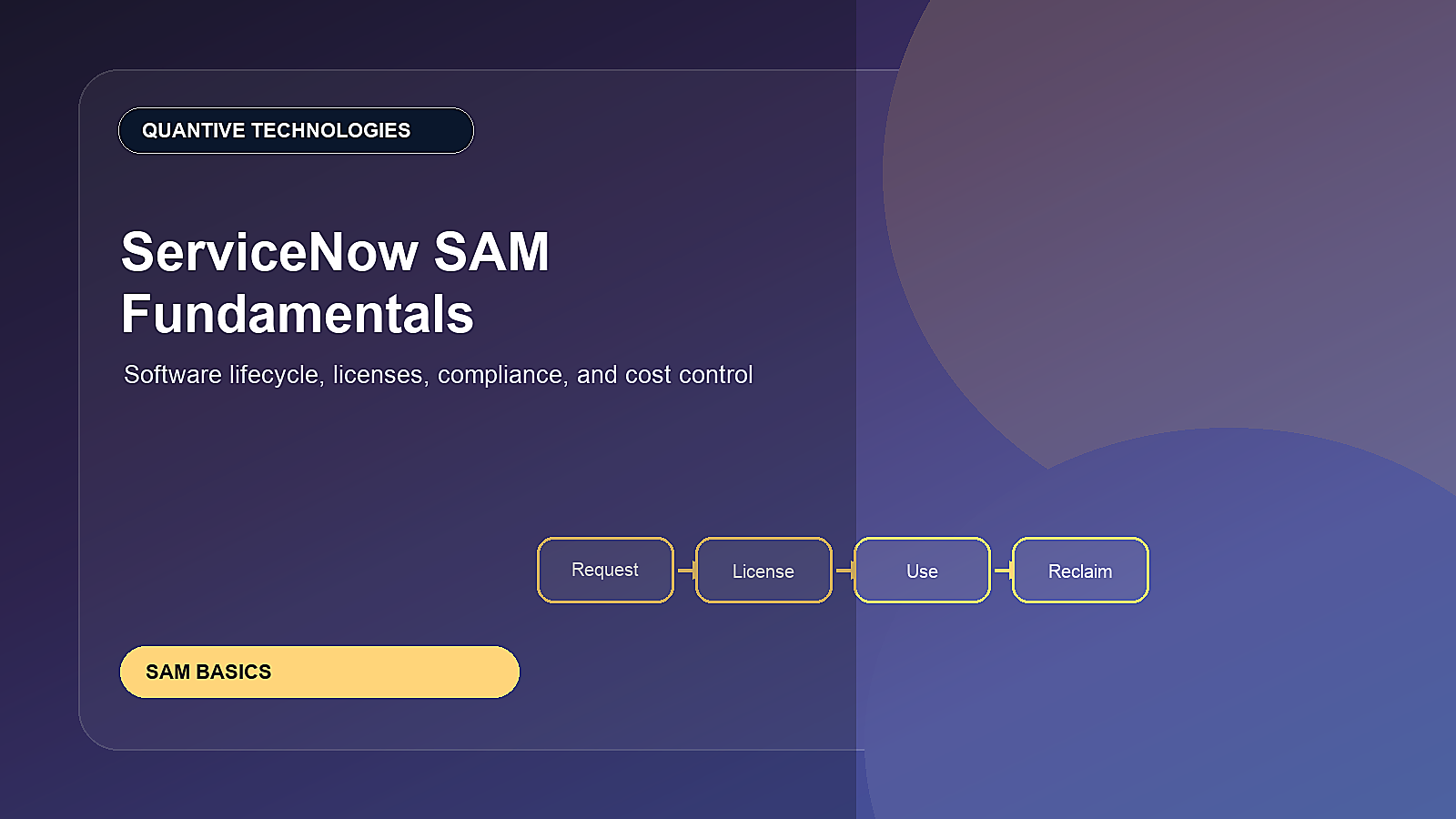
A healthy SAM program connects software request, approval, procurement, entitlement import, discovery, usage, optimization, renewal, and retirement. The goal is not only compliance. It is better software value management.
- Capture software demand through controlled request workflows.
- Import contracts, entitlements, and subscription details accurately.
- Normalize software models so reports do not fragment by naming variation.
- Compare entitlement, installation, and usage data regularly.
- Reclaim unused software and feed savings into procurement and renewal planning.
Beginner checklist
If you are new to ServiceNow SAM, use this checklist to understand whether your foundation is ready.
- Do you know your top software publishers by spend and risk?
- Are entitlements and contracts captured in a structured way?
- Can you compare installations and usage against rights?
- Do request workflows prevent uncontrolled purchasing?
- Can you identify unused software before renewal?
Common mistakes to avoid
- Thinking SAM is only audit defense instead of lifecycle value management.
- Loading entitlement data without normalizing software models.
- Ignoring usage and only counting installations.
- Letting business units buy software without visibility.
- Waiting until renewal month to analyze optimization opportunities.
Metrics leaders should track
- Compliance position by publisher or product.
- Unused or underused software value.
- License reclamation savings.
- Renewal exposure by quarter.
- Software request approval and fulfillment cycle time.
How it connects to the broader ServiceNow roadmap
SAM is a core part of ServiceNow IT Asset Management. It connects to request workflows in ServiceNow IT Service Management, publisher and contract ServiceNow Data Integration through ServiceNow Data Integration, Risk Management controls in Risk Management, and optimization dashboards in Performance Analytics.
Practical next step
Start with one high-spend or high-risk publisher. Clean entitlement data, normalize discovered software, compare usage, and identify immediate reclamation or renewal opportunities.
Who uses SAM data?
SAM data is useful to several teams. IT uses it to control software requests and deployments. Procurement uses it for renewals and negotiations. Finance uses it to understand spend. Security uses it to identify unmanaged tools. Compliance uses it to prepare for publisher reviews. Business owners use it to decide whether a tool still delivers value.
A simple SAM maturity path
- Foundation: Identify top publishers, contracts, entitlements, installations, and owners.
- Optimization: Compare usage to rights and reclaim unused licenses.
- Governance: Add request controls, renewal workflows, publisher risk dashboards, and business owner accountability.
- Strategic planning: Use SAM data for SaaS rationalization, FinOps, application portfolio decisions, and budget planning.
Example for beginners
A department asks for 100 more licenses for a design tool. Without SAM, the company may buy more. With SAM, the team can check whether unused licenses already exist, whether the request aligns with entitlement terms, and whether the software overlaps with another approved tool.
Why SAM is not only compliance
Compliance matters, but the strongest SAM programs also improve value. They reduce waste, prevent uncontrolled buying, support better renewals, and give leaders confidence that software spend is connected to real usage.
Quantive Technologies perspective
Quantive Technologies helps organizations build ServiceNow SAM foundations, clean software ServiceNow Data Integration, align publisher priorities, automate request controls, and create measurable optimization roadmaps.
Need help turning this into a ServiceNow roadmap?
For more information or a focused implementation discussion, please reach out to info@quantivetech.com or book your discovery call.