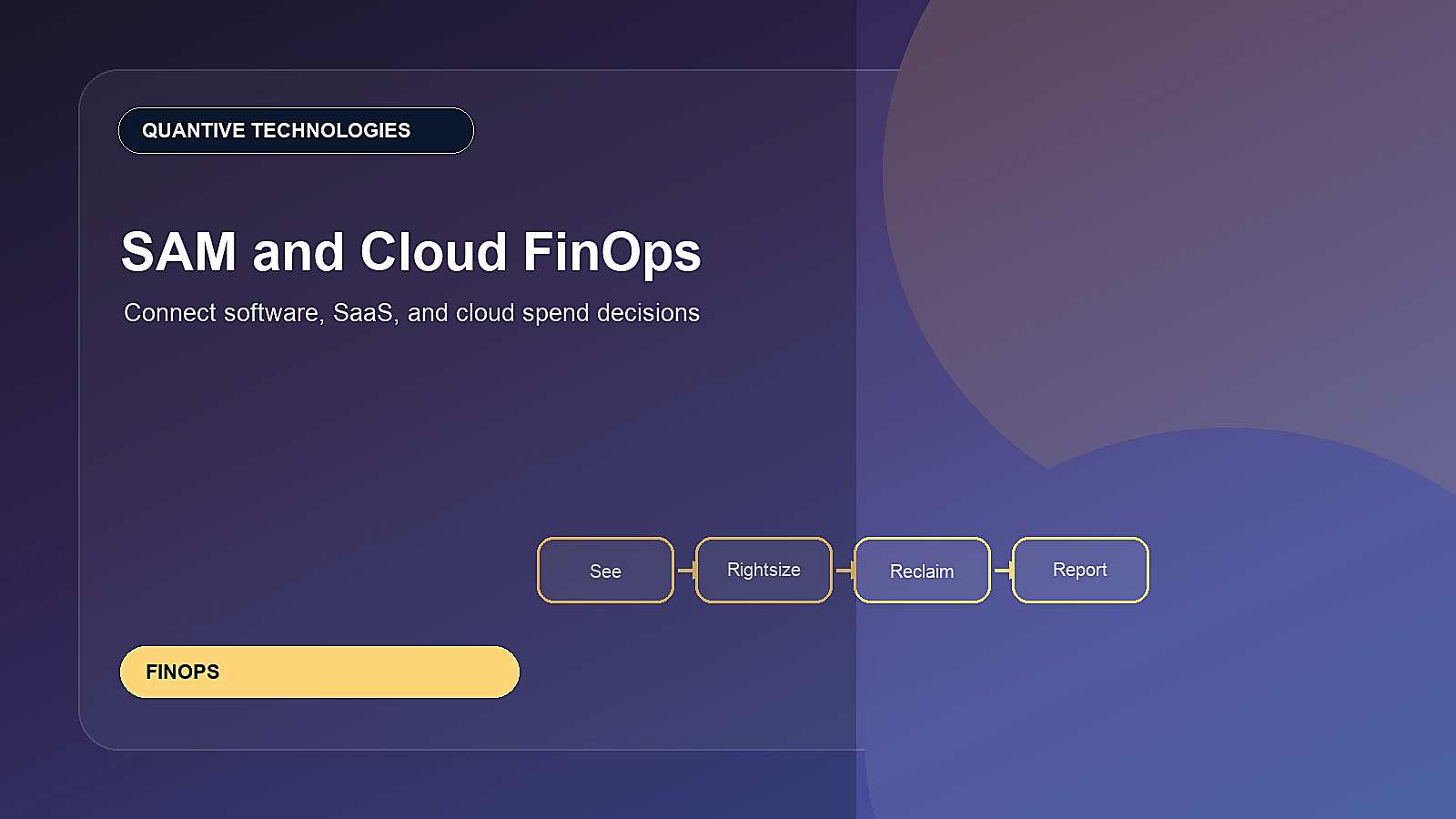
ServiceNow SAM and FinOps share a common goal: help organizations understand technology consumption, ownership, and cost so they can make better spend decisions.
Software and cloud spending are often managed by different teams, but the decisions are connected. A workload may require a cloud subscription, operating system licenses, database licenses, middleware, SaaS integrations, and support contracts. SAM gives software context, while FinOps adds cloud consumption discipline.
Article at a glance
Why this matters: ServiceNow SAM is most valuable when license, entitlement, usage, renewal, cloud, and SaaS signals are connected to decisions. The article should help readers move from inventory visibility to cost, risk, and compliance action.
How to apply this guidance
| Step | What to clarify |
|---|---|
| 1. Confirm evidence | Validate entitlement, usage, deployment, renewal, owner, and cost evidence before making compliance or savings decisions. |
| 2. Create action paths | Turn findings into reclamation, renewal, audit, rationalization, and approval workflows. |
| 3. Measure outcomes | Track compliance position, reclaimed licenses, avoided spend, renewal risk, and cycle time for remediation. |
Use the rest of the article as a planning checklist: confirm the target outcome, test the workflow and data assumptions, then connect governance, ownership, measurement, and adoption before expanding the use case.
What SAM and FinOps mean together
SAM focuses on software rights, usage, compliance, and optimization. FinOps focuses on cloud cost visibility, accountability, and value. Together, they help teams understand whether software and cloud spend are aligned with actual business use.
Why this matters now
Cloud adoption, SaaS growth, and AI workloads are increasing technology spend complexity. Finance, IT, procurement, and engineering teams need a shared language for cost, usage, ownership, and optimization opportunities.
Core concepts to understand
| Concept | What it means | Why it matters |
|---|---|---|
| Consumption | What software, SaaS, or cloud resources are being used | Shows where spend is actually going |
| Ownership | The team accountable for the cost or service | Enables chargeback, showback, and accountability |
| Optimization | Rightsizing, reclaiming, renegotiating, or retiring unused resources | Reduces waste without hurting productivity |
| License mobility | Rules for using software in cloud or virtual environments | Can affect compliance and cost |
| Showback | Reporting spend and usage to owners | Improves decision-making without immediate chargeback |
How SAM supports FinOps decisions
SAM can provide software entitlement, usage, compliance, and renewal context. FinOps can provide cloud consumption and cost context. When these views connect, teams can make better decisions about deployment, renewal, migration, and optimization.
- Identify software products that contribute to cloud or subscription spend.
- Map costs to owners, services, applications, or departments.
- Compare usage against rights, subscriptions, and cloud consumption.
- Trigger optimization actions such as rightsizing, reclaiming, or renegotiating.
- Report savings opportunities to finance, procurement, and service owners.
Beginner checklist
If you are new to ServiceNow SAM and FinOps, use this checklist to understand whether your foundation is ready.
- Do software and cloud teams share ownership data?
- Can you connect subscription spend to actual usage?
- Are cloud-hosted software license rules understood?
- Do renewal and migration decisions include cost and compliance context?
- Can leaders see software, SaaS, and cloud optimization opportunities together?
Common mistakes to avoid
- Treating SAM and FinOps as unrelated programs.
- Optimizing cloud cost without checking software license impact.
- Renewing software before checking cloud migration or usage plans.
- Reporting cost without service or owner context.
- Ignoring SaaS spend because it does not look like traditional software licensing.
Metrics leaders should track
- Software and SaaS spend by owner or service.
- Cloud-hosted software compliance exposure.
- Unused subscription and cloud resource value.
- Optimization savings accepted and realized.
- Renewals influenced by usage or migration data.
How it connects to the broader ServiceNow roadmap
SAM and FinOps should connect ServiceNow IT Asset Management, ServiceNow Data Integration, application and service ownership, Risk Management controls in Risk Management, and optimization dashboards through Performance Analytics.
Practical next step
Pick one cloud-hosted software publisher or one major SaaS platform. Map entitlement, usage, owner, renewal date, and consumption cost before deciding the optimization action.
Shared taxonomy is the starting point
SAM and FinOps teams need common ownership fields. Application, service, cost center, environment, business owner, and technical owner should be used consistently. Without a shared taxonomy, cost reports do not lead to action because nobody knows who should decide.
Showback before chargeback
Many organizations start with showback: reporting spend and usage to owners without directly billing them. This helps teams understand consumption and change behavior. Once data quality and ownership improve, chargeback or budget allocation becomes more realistic.
License impact of cloud decisions
Moving workloads to cloud can change software licensing requirements. Some products have rules for virtual cores, bring-your-own-license rights, database editions, disaster recovery, or indirect usage. SAM context helps FinOps decisions avoid accidental compliance or cost problems.
Optimization examples
A team may rightsize cloud resources but still pay for unused software. Another team may reclaim SaaS seats but keep oversized cloud environments. Connecting SAM and FinOps helps identify the full optimization opportunity across software, SaaS, and infrastructure consumption.
Quantive Technologies perspective
Quantive Technologies helps teams connect SAM, SaaS, cloud cost, ownership, and analytics so optimization decisions are practical, measurable, and aligned with business services.
Need help turning this into a ServiceNow roadmap?
For more information or a focused implementation discussion, please reach out to info@quantivetech.com or book your discovery call.