
Many organizations continue to underestimate the CMDB because they view it simply as an inventory of IT components rather than a logical model of services, relationships, and dependencies. Without structure, governance, and accurate data, a CMDB becomes incomplete, untrusted, and ultimately unused.
A mature CMDB, however, is foundational to IT operations, service delivery, automation, and resilience. ServiceNow helps organizations transform their CMDB from a static database into a service-aware, continuously updated system of record.
Why Organizations Underestimate the CMDB
- Treating the CMDB as an Inventory Instead of a Service Model
Many teams load asset lists or device spreadsheets into the CMDB and assume it’s fully built.
But a true CMDB models:
- Configuration Items (CIs)
- Relationships
- Dependencies that impact services
Without relationship mapping and service modeling, organizations lose the ability to perform impact analysis, root-cause identification, or effective service monitoring.
- Data Quality Quietly Erodes Value
A CMDB is only as good as its data. Common failures include:
- Stale or outdated CIs
- Duplicate or conflicting entries
- Missing relationships
- Lack of ownership and lifecycle policies
When accuracy drops, teams stop relying on the CMDB — creating a cycle where low trust leads to low adoption, and low adoption worsens data quality.
- No Consistent CI Classification Standards
A CMDB cannot function without consistent modeling. Without standardized CI classes, organizations struggle with:
- Mandatory CI attributes
- Valid relationship rules
- Lifecycle enforcement
- Normalization and reconciliation
This inconsistency creates fragmentation, making automation and discovery far less effective.
- Poor Integration with ITSM, ITOM, and Business Services
A CMDB that operates in isolation provides little real value.
When it is not connected to processes such as:
- Incident Management
- Change Management
- Problem Management
- Discovery
- Monitoring
- Service Mapping
It becomes static, outdated, and operationally irrelevant.
How ServiceNow Solves These Challenges
ServiceNow provides a complete ecosystem for CMDB accuracy, governance, automation, and service mapping, turning the CMDB into a powerful operational backbone.
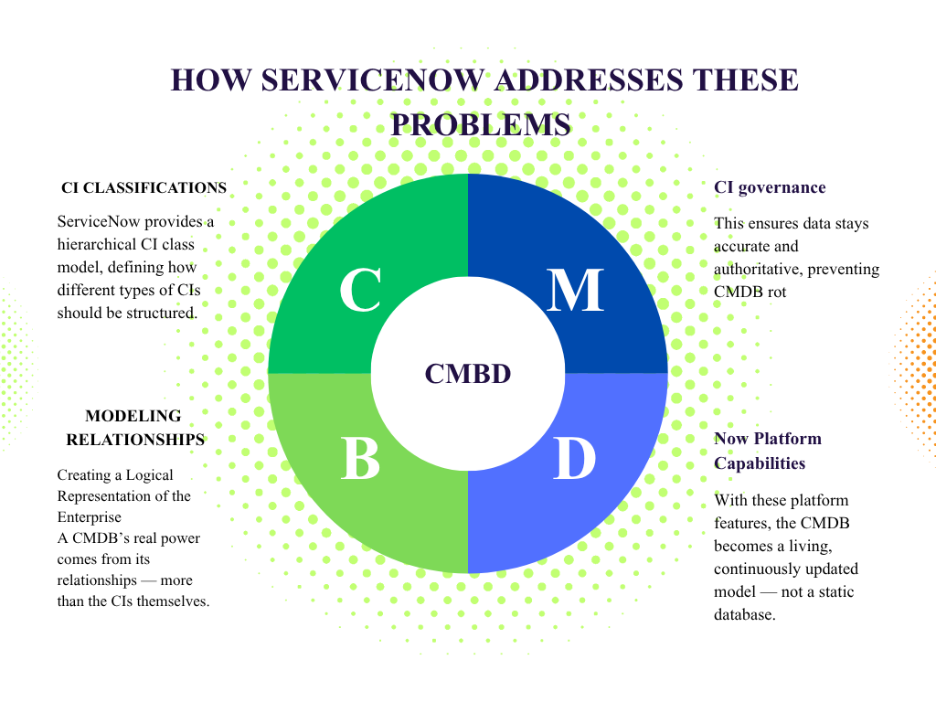
CI Classification: Enforcing Structure and Standardization
ServiceNow offers a rich, hierarchical CI class model that helps organizations:
- Enforce consistent CI attributes
- Apply mandatory fields
- Maintain data schema integrity
- Enable accurate discovery and reconciliation
A strong class model prevents drift and ensures scalable, reliable CI modeling.
Relationship Modeling: Building a Logical Service Topology
The true value of a CMDB comes from relationships — not just the CIs.
ServiceNow allows modeling of:
- Runs on
- Depends on
- Hosted on
- Provides / consumes relationships
These relationships support:
- Change impact analysis
- Incident triage
- Root-cause investigation
- End-to-end service health monitoring
The result: a fully service-aware CMDB that shows how infrastructure, applications, and services interconnect.
CI Lifecycle Governance
ServiceNow automates governance across the CI lifecycle:
- Identification
- Population
- Reconciliation
- Normalization
- Decommissioning
This ensures data remains accurate, trusted, and continuously maintained.
Now Platform Capabilities: Automation, Discovery, Workflow, Intelligence
The Now Platform enhances CMDB effectiveness through:
- Automated workflows that enforce data policies
- CMDB Health Dashboards and data quality scoring
- Integration with ITSM, ITOM, SecOps, and other modules
- Native support for hybrid and multi-cloud environments
These capabilities transform the CMDB into a living, continuously updated model, not a static record.
How to Build a Service-Aware CMDB in ServiceNow
- Define CI Classes and Attributes
Create a predictable schema that standardizes data structure.
- Map Relationships and Dependencies
Model how infrastructure supports applications and how applications support business services.
- Integrate Automated Data Sources
Use Discovery, Service Mapping, integrations, and orchestration to populate accurate CI data.
- Establish Governance
Assign ownership, define policies, monitor health, and enforce reconciliation rules.
- Connect the CMDB to ITSM and ITOM
Use CMDB data to power change, incident, problem, monitoring, and service mapping processes.
- Continuously Optimize
Refine classes, validate relationships, and improve modeling as systems evolve.
Conclusion
Organizations underestimate the CMDB because they treat it as an asset list rather than a dynamic model of services and dependencies.
ServiceNow transforms the CMDB by providing:
- Structured CI classification
- Advanced relationship modeling
- Lifecycle governance
- Automated data population and intelligence
A well-implemented, service-aware CMDB enables real-time visibility, operational stability, and smarter decision-making across IT.
Ready to elevate your CMDB strategy and build a truly service-aware configuration model?
Connect with a trusted ServiceNow partner to modernize your CMDB and unlock the full value of the Now Platform.
If you’re looking to elevate your CMDB strategy, strengthen IT operations, or build a truly service-aware configuration model on ServiceNow, our experts are here to help. Connect with us to explore how your organization can unlock real-time visibility, operational stability, and smarter decision-making through a well-implemented CMDB.
For more information, reach out to: info@quantivetech.com