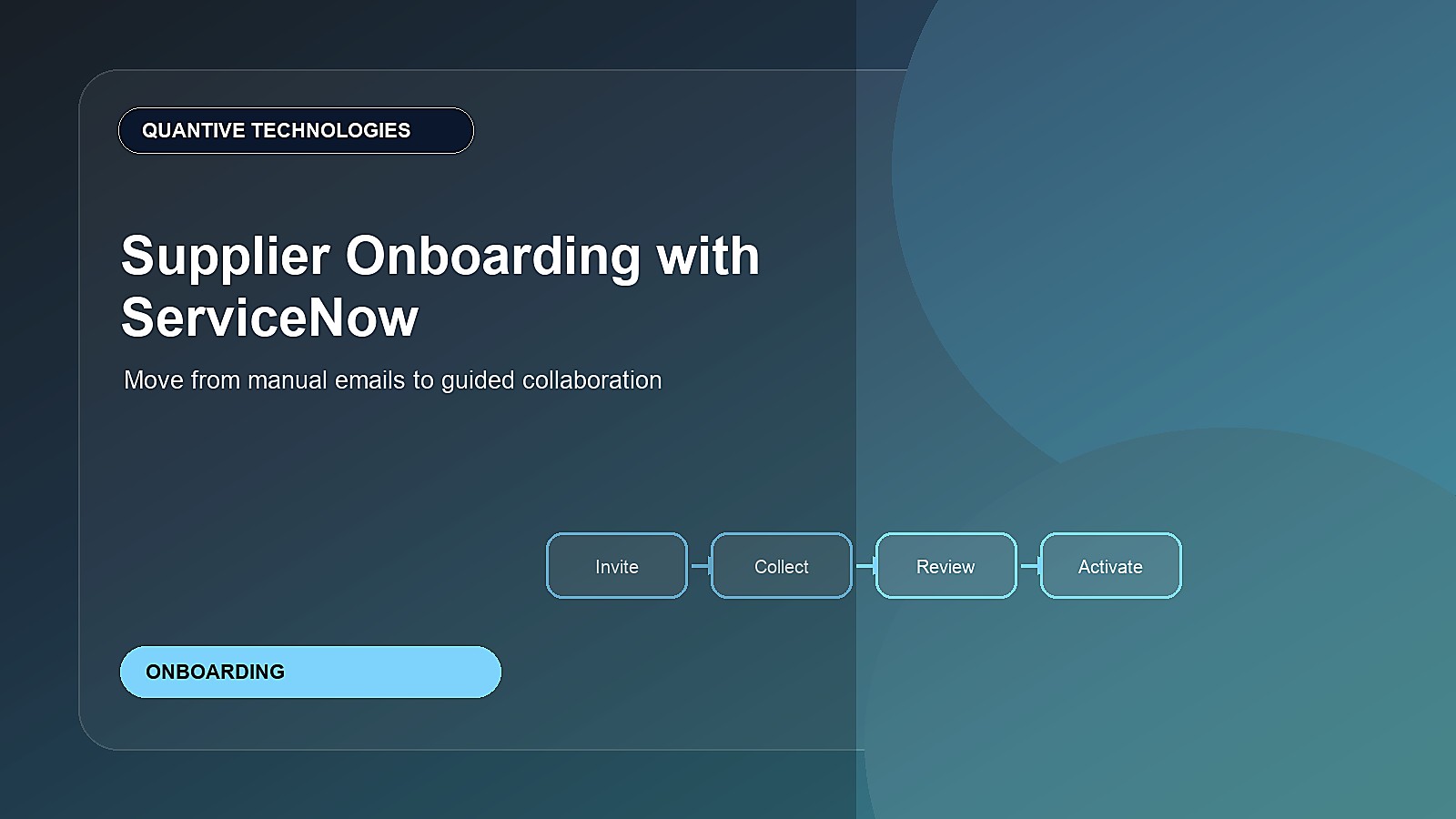
Supplier Onboarding with ServiceNow: From Manual Emails to Guided Collaboration is more than a product update. It is a signal that enterprise workflows are becoming more connected, more intelligent, and more measurable. This article focuses on how supplier onboarding can become structured, visible, and easier for suppliers and internal teams.
Manual supplier onboarding creates repeated follow-up, missing documentation, unclear status, and delayed supplier activation. Supplier Lifecycle Operations supports a more guided supplier experience at a time when resilience and supplier risk are strategic priorities.
Article at a glance
Why this matters: ServiceNow Supplier Lifecycle Operations focuses on a unified digital experience for onboarding, offboarding, collaboration, and ongoing supplier engagement. The article should make the supplier relationship feel operational, measurable, and connected. In this article, the practical focus is supplier onboarding that moves from manual email coordination to guided collaboration.
How to apply this guidance
| Step | What to clarify |
|---|---|
| 1. Standardize supplier records | Define required supplier profile, risk tier, ownership, documents, certifications, and system-of-record rules. |
| 2. Guide collaboration | Move onboarding, updates, cases, document requests, and supplier-side tasks into transparent workflow experiences. |
| 3. Track performance and risk | Use analytics to monitor cycle time, issue aging, SLA performance, compliance gaps, and collaboration quality. |
Use the rest of the article as a planning checklist: first confirm the business outcome, then test the workflow, data, ownership, integration, governance, and measurement assumptions before expanding the use case.
Who should read this
This guide is written for procurement teams, supplier managers, finance operations, risk reviewers, and shared services teams. The goal is to help teams move from awareness to practical planning without treating AI or workflow automation as a one-off experiment.
What readers need to know
- Give suppliers a clear set of tasks and required documents.
- Route internal reviews by supplier risk and category.
- Make onboarding status visible to suppliers and business sponsors.
- Capture evidence for auditability and future renewals.
Implementation roadmap
A strong implementation should start with operating-model clarity before configuration. Teams need to know who owns the process, which records are trusted, where approvals happen, and how value will be measured after rollout.
- Map current onboarding steps and owners.
- Create supplier-facing task lists and status updates.
- Define internal review workflows for tax, finance, legal, security, and risk.
- Measure onboarding bottlenecks and document completeness.
High-value use cases to prioritize
The best first wave should be visible enough to matter, but bounded enough to deliver without waiting for a multi-year transformation program. Look for workflows with high volume, repeated manual follow-up, clear ownership, and measurable business impact.
Good candidates usually have three signals: requesters regularly ask for status, teams re-enter the same information in multiple systems, and managers cannot easily see where work is blocked. Those signals indicate that workflow orchestration, AI assistance, and analytics can create value quickly.
90-day action plan
In the first 30 days, confirm the business owner, current-state process, data sources, approval points, and the baseline metrics. In the next 30 days, design the future-state workflow, integration needs, reporting model, and change-management approach. In the final 30 days, build a controlled pilot, validate user experience, and compare early results against the baseline.
This phased approach keeps the work practical. It also gives executives a clearer view of whether the initiative is improving speed, quality, control, and user experience before the rollout expands.
Planning table
| Focus area | Decision to make | Metric to watch |
|---|---|---|
| Priority 1 | Give suppliers a clear set of tasks and required documents. | Time to activate supplier |
| Priority 2 | Route internal reviews by supplier risk and category. | Missing document rate |
| Priority 3 | Make onboarding status visible to suppliers and business sponsors. | Supplier task completion |
| Priority 4 | Capture evidence for auditability and future renewals. | Internal review aging |
Metrics that prove value
Leadership teams should avoid measuring only activity. The stronger question is whether the workflow is faster, safer, easier to use, and more transparent than the old process.
- Time to activate supplier
- Missing document rate
- Supplier task completion
- Internal review aging
- Onboarding satisfaction
Common rollout risks
The most common risk is launching technology before the workflow is ready. Other risks include unclear ownership, weak data quality, missing integration points, insufficient change management, and dashboards that do not connect to business outcomes.
Quantive Technologies perspective
Quantive Technologies recommends treating this as a business workflow initiative first and a platform configuration effort second. The best results come when process design, data integration, AI governance, analytics, and user adoption are planned together.
For implementation planning, this connects naturally with ServiceNow Data Integration, Performance Analytics, and ServiceNow Risk Management.
Need help turning this into a ServiceNow roadmap?
For more information or a focused implementation discussion, please reach out to info@quantivetech.com or book your discovery call.