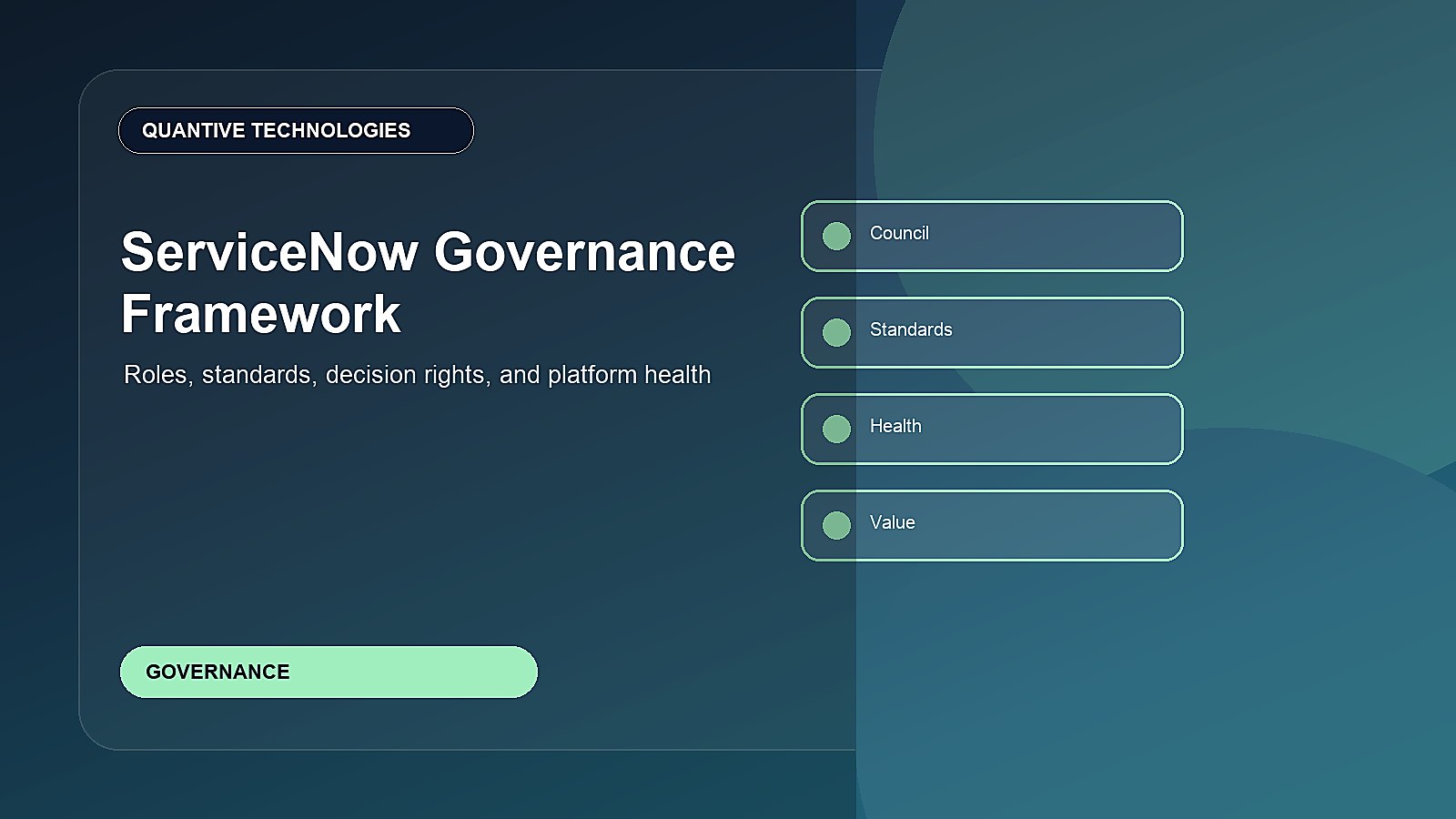
ServiceNow governance is the operating model that keeps the platform healthy as more teams, workflows, integrations, and AI use cases depend on it.
Many ServiceNow programs start with implementation energy and then struggle during scale. New requests arrive from every direction, teams create their own patterns, integrations multiply, customizations grow, and leaders lose a clear view of platform health. Governance prevents that drift.
Article at a glance
Why this matters: ServiceNow governance now has to cover workflows, data, integrations, releases, AI, security, and measurable business value. Readers need a practical way to turn governance from policy into daily decisions.
How to apply this guidance
| Step | What to clarify |
|---|---|
| 1. Clarify ownership | Define who owns platform strategy, process decisions, data quality, release control, risk acceptance, and value tracking. |
| 2. Set usable standards | Publish standards for intake, catalog design, roles, integrations, reporting, AI use, and technical debt handling. |
| 3. Review health and value | Use recurring evidence-based reviews to connect platform health, backlog, adoption, risk, and measurable outcomes. |
Use the rest of the article as a planning checklist: confirm the target outcome, test the workflow and data assumptions, then connect governance, ownership, measurement, and adoption before expanding the use case.
Good governance does not mean slowing everyone down. It means making clear decisions about ownership, standards, Risk Management, value, release control, and ServiceNow Data Integration quality so the platform can grow without becoming fragile.
Why governance matters now
The platform is no longer used only by the service desk. It may support IT, HR, customer service, procurement, Risk Management, operations, asset management, AI workflows, employee experience, and executive reporting. Without governance, each new use case can introduce design inconsistency and long-term technical debt.
AI and automation also raise the standard. If permissions, knowledge, ServiceNow Data Integration, catalog items, assignment groups, and ownership are inconsistent, AI-assisted work becomes harder to trust. Governance is the foundation that makes innovation safer.
What good governance looks like
A practical governance framework should define who owns the platform, who approves standards, who decides roadmap priority, who monitors health, who accepts Risk Management, and who measures value. It should be visible enough for business teams to understand and lightweight enough for delivery teams to use.
The strongest models usually include an executive sponsor, platform owner, architecture/design authority, process owners, ServiceNow Data Integration owners, release manager, security owner, and value owner. The exact names can vary, but the decision rights must be explicit.
Key governance areas
| Governance area | What to define | Why it matters |
|---|---|---|
| Decision rights | Who approves roadmap, architecture, integrations, risk exceptions, and major design choices | Prevents confusion and repeated debate |
| Design standards | Naming, data model, workflow, catalog, role, integration, and reporting conventions | Keeps the platform consistent and maintainable |
| Health reviews | Recurring checks for technical debt, defects, unused assets, performance, security, and data quality | Catches issues before they become expensive |
| Value tracking | Measures adoption, cycle time, automation, experience, savings, risk reduction, and backlog outcomes | Keeps governance tied to business benefit |
| Risk management | Controls for sensitive data, access, AI, integrations, update readiness, and compliance requirements | Allows innovation without unmanaged exposure |
A starter governance roadmap
- Create a platform charter that explains the platform purpose, business outcomes, and governance scope.
- Define a small governance council with decision rights, meeting cadence, and escalation paths.
- Publish standards for demand intake, workflow design, ServiceNow Data Integration ownership, naming, roles, releases, and integrations.
- Set a monthly platform health review that looks at defects, backlog, technical debt, performance, security, ServiceNow Data Integration quality, and value.
- Use Platform Care AI as a supporting product layer to keep platform health and improvement signals visible between governance meetings.
Common mistakes to avoid
- Treating governance as a meeting instead of an operating system for decisions.
- Creating too many approval gates without clear value.
- Letting every team design catalog items, workflows, and reports differently.
- Reviewing project delivery but not platform health or technical debt.
- Ignoring adoption and business outcomes after go-live.
Metrics leaders should monitor
- Open platform risks, exceptions, and overdue decisions.
- Technical debt items by severity, age, and owner.
- Demand backlog by value, effort, Risk Management, and strategic alignment.
- Adoption, cycle time, SLA health, automation rate, and experience score by service area.
- Update readiness, skipped upgrades, deprecated assets, and customization Risk Management.
Where Platform Care AI helps
Platform Care AI can support governance by giving leaders a clearer view of platform health, Risk Management signals, technical debt, and improvement priorities between formal review cycles.
- Track health indicators that should be reviewed by the platform owner and governance council.
- Surface improvement opportunities so governance discussions are based on evidence instead of opinions.
- Help teams prioritize technical debt, Risk Management, and operational hygiene as part of the platform roadmap.
How this connects across ServiceNow
Governance connects to ServiceNow consulting services, Performance Analytics, Risk Management, ServiceNow Data Integration, ServiceNow IT Service Management, and ServiceNow IT Operations Management. The goal is to make sure every ServiceNow capability follows a shared operating model while still allowing teams to deliver useful work quickly.
Practical next step
Start by writing a one-page governance charter. Include platform purpose, roles, decision rights, standard review areas, and the metrics that leadership will inspect every month.
Quantive Technologies perspective
Quantive Technologies helps organizations design ServiceNow governance models that are practical, measurable, and connected to platform health. We also position Platform Care AI as a continuous product layer for monitoring governance signals and improvement opportunities.
Need help turning this into a ServiceNow roadmap?
For more information or a focused implementation discussion, please reach out to info@quantivetech.com or book your discovery call.