CSDM implementation works best when it is treated as an operating model, not only a ServiceNow Data Integration model. The goal is to make services, owners, applications, and support relationships clear enough for people and workflows to use.
Many ServiceNow teams know they need CSDM, but they are unsure where to start. Should they define business services first? Should they map applications? Should they clean the CMDB before modeling services? The answer depends on business priorities, but the safest path is usually phased and outcome driven.
Article at a glance
Why this matters: CMDB and CSDM work is the foundation for impact analysis, service operations, risk decisions, AI readiness, and executive reporting. Readers need practical guidance that connects data quality to business service outcomes.
How to apply this guidance
| Step | What to clarify |
|---|---|
| 1. Define the model | Clarify the service, application, infrastructure, owner, and dependency model before expanding data ingestion. |
| 2. Control sources | Decide which discovery, connector, integration, and manual sources are trusted for each data class. |
| 3. Measure health | Track completeness, correctness, relationship quality, freshness, ownership, and service coverage. |
Use the rest of the article as a planning checklist: confirm the target outcome, test the workflow and data assumptions, then connect governance, ownership, measurement, and adoption before expanding the use case.
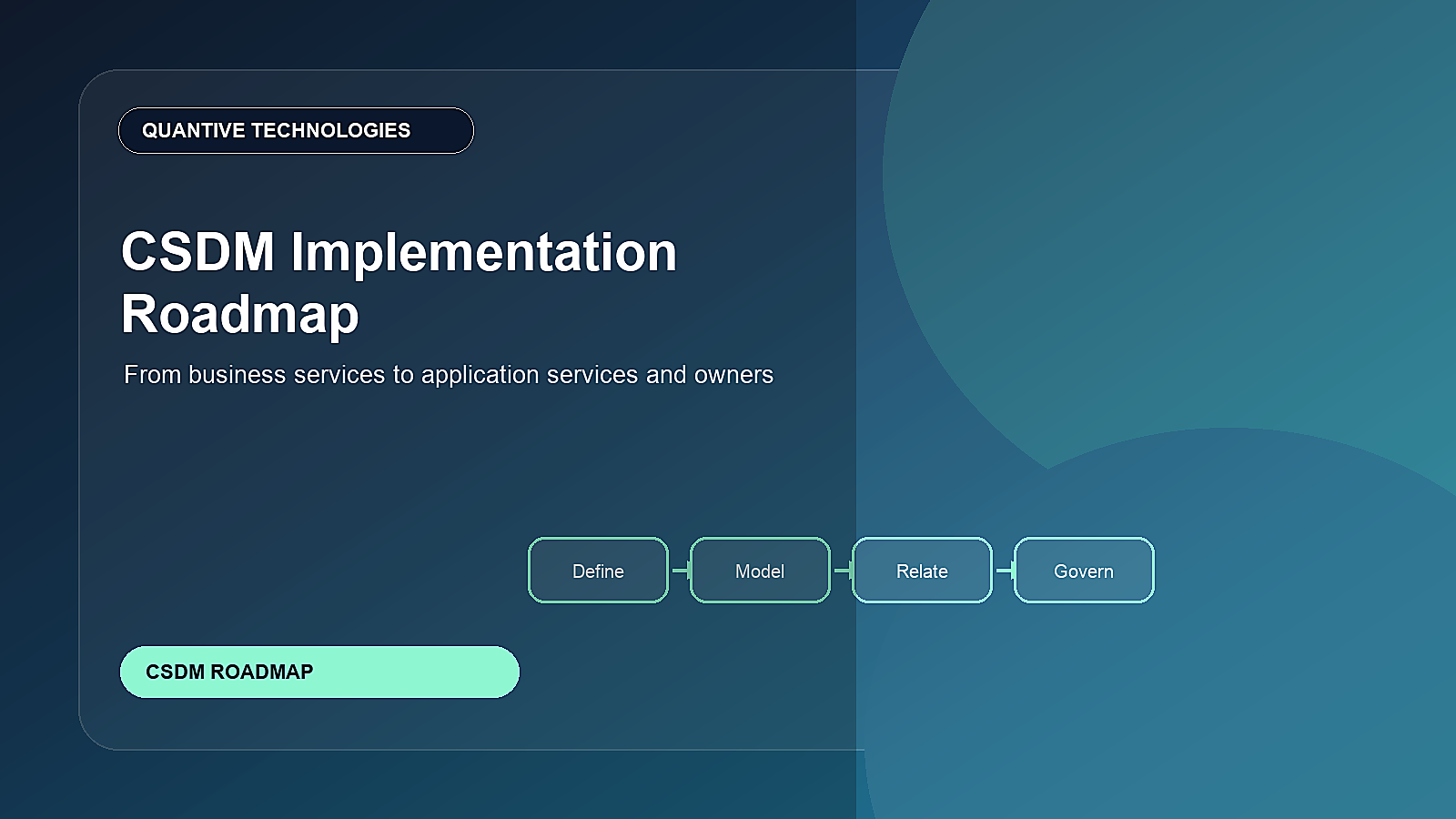
A CSDM roadmap should help teams agree on service language, model the highest-value services, connect application and technical context, and create governance so the model does not decay after launch.
Why this is trending now
Organizations are under pressure to improve service visibility, AI readiness, operational resilience, change Risk Management, and portfolio decisions. All of those depend on a shared service model. Without CSDM, different teams create different definitions for services, applications, offerings, and owners, which makes automation and reporting weaker.
CSDM is also becoming more important as ServiceNow programs expand beyond ITSM into ITOM, asset management, Risk Management, customer workflows, and AI-assisted operations. A consistent model helps these areas speak the same language.
Beginner-friendly explanation
For a new reader, start with the word service. A business service is what the business consumes, such as employee onboarding, payroll, digital banking, claims processing, or order management. An application service is the application capability that supports a service. A technical service may represent platform, infrastructure, or support capability used behind the scenes.
CSDM helps separate these layers so the organization can understand what the user experiences, what applications support it, who owns it, and which teams maintain it. That separation improves accountability and impact analysis.
Core concepts to understand
| Concept | What it means | Why it matters |
|---|---|---|
| Business service | A service consumed by business users or customers | Creates a business-facing view of value and impact |
| Service offering | A specific package, level, or option for a service | Supports catalog, SLA, reporting, and service ownership clarity |
| Application service | A deployed application capability that supports work | Links applications to incidents, changes, operations, and service impact |
| Technical service | A technology service or capability that supports application or business services | Improves support responsibility and operational planning |
| Owner and steward | People accountable for the service and the quality of service data | Prevents the model from becoming stale |
A phased CSDM operating model
The best roadmap starts with scope. Pick a business area, critical applications, or a high-Risk Management service line. Define what questions CSDM must answer, such as who owns the service, what is impacted by incidents, what changes create Risk Management, or which services support a business capability.
Then build the model in layers. Start with services and owners, add application services, add key technical dependencies, and connect operational workflows. Governance should run alongside the build so ownership, naming standards, and change control are clear from the beginning.
- Define a service taxonomy that business and IT teams can understand.
- Create naming standards for business services, offerings, application services, and technical services.
- Assign owners and ServiceNow Data Integration stewards before large-scale ServiceNow Data Integration loading.
- Connect service records to request, incident, change, problem, monitoring, and asset processes.
- Review the model through live use cases, not only ServiceNow Data Integration completeness reports.
Practical implementation roadmap
- Phase 1: align on service definitions, scope, target outcomes, and governance roles.
- Phase 2: model the first wave of business services, offerings, and owners.
- Phase 3: connect application services, support groups, and key relationships.
- Phase 4: use the model in change Risk Management, incident impact, service dashboards, and service catalog decisions.
- Phase 5: expand to more services, automate ServiceNow Data Integration maintenance, and use CSDM for AI-ready context.
Common mistakes to avoid
- Trying to model the entire enterprise before proving value in one service area.
- Using service names that only technical teams understand.
- Skipping business owner alignment and then struggling with adoption.
- Confusing application records with application services.
- Measuring success only by number of records created instead of workflow outcomes improved.
Metrics leaders should track
- Critical services modeled with owner, offering, application service, and support group.
- Changes assessed with service impact information.
- Incidents routed or prioritized using service context.
- Services with stale owner, missing relationship, or unclear support group.
- Business areas using CSDM ServiceNow Data Integration in dashboards or governance reviews.
How this connects across ServiceNow
CSDM is the connective layer between service strategy and operational execution. It helps ServiceNow IT Service Management processes understand business impact, helps ServiceNow IT Operations Management map technology signals to services, helps ServiceNow IT Asset Management connect assets and applications to value, and helps Performance Analytics report on service health in language leaders can use.
90-day action plan
- Days 1-30: interview service owners, application teams, operations, and service desk leaders to agree on the first modeling scope.
- Days 31-60: create the first service model, validate definitions, assign owners, and identify missing relationships.
- Days 61-90: connect the model to incidents, changes, requests, and dashboards so users see practical value.
Quantive Technologies perspective
Quantive Technologies helps teams design CSDM roadmaps that are realistic, measurable, and connected to operating value. We help define the model, clean ServiceNow Data Integration, align owners, connect services to workflows, and create dashboards through Performance Analytics so the roadmap becomes usable, not theoretical.
Need help turning this into a ServiceNow roadmap?
For more information or a focused implementation discussion, please reach out to info@quantivetech.com or book your discovery call.