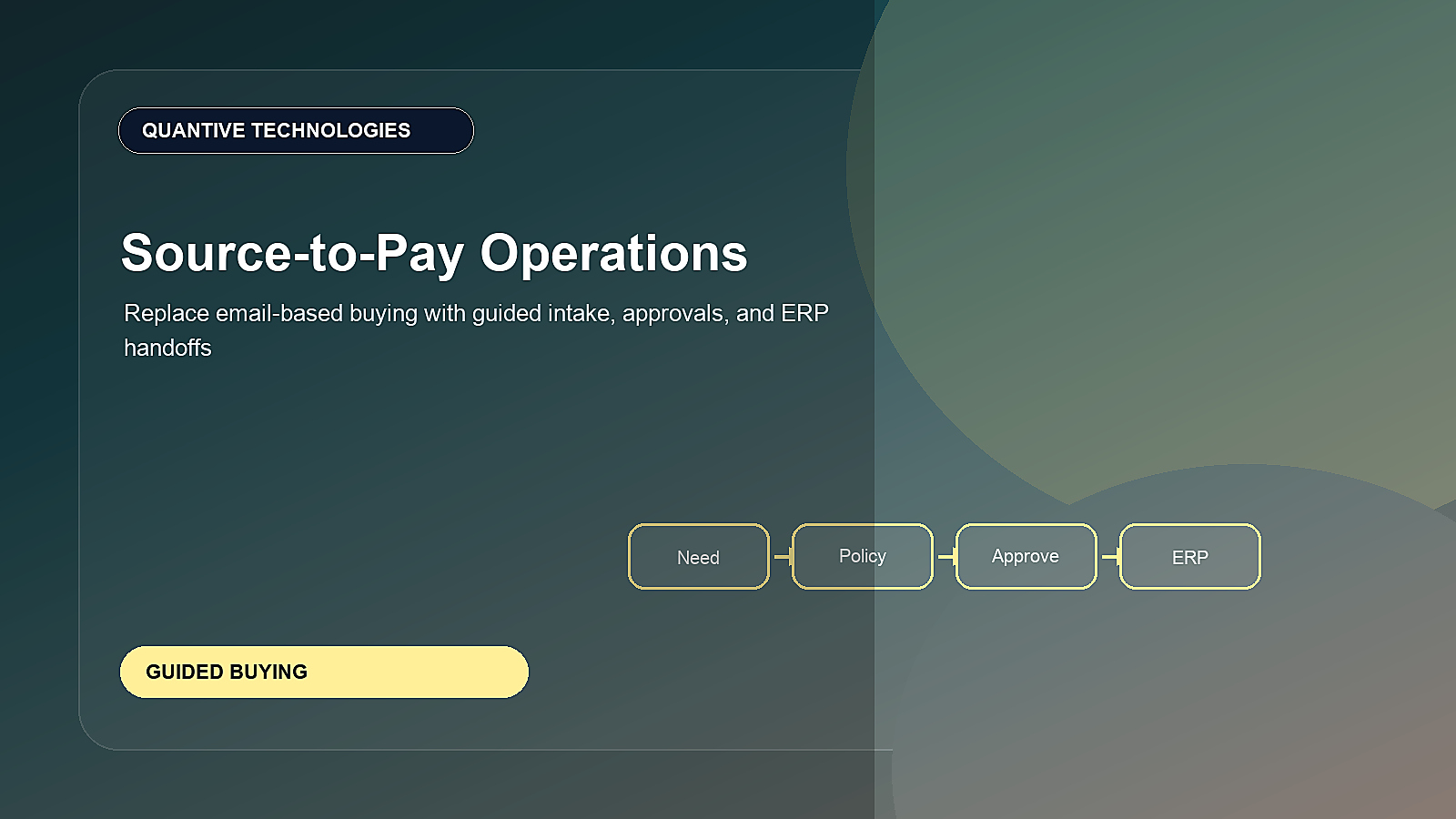
Email-based buying feels flexible until the volume grows. A requester sends a message, a manager approves in a thread, procurement asks for missing details, finance checks budget, legal reviews terms, and someone eventually updates ERP. The request may move forward, but the organization loses visibility, consistency, and control.
ServiceNow Source-to-Pay Operations gives organizations a better model: guided procurement intake, policy-aware approvals, supplier context, and integration-ready handoffs. The goal is not simply to digitize a request form. The goal is to turn buying work into a visible workflow.
Article at a glance
Why this matters: Email-based buying hides demand, weakens policy compliance, slows approvals, and creates messy ERP handoffs. Guided procurement makes the request path visible and measurable.
How to apply this guidance
| Step | What to clarify |
|---|---|
| 1. Classify intake | Separate catalog buying, services, software, supplier requests, exceptions, and high-risk purchases. |
| 2. Embed policy | Guide requesters with the right questions, approvals, budget checks, supplier rules, and risk criteria. |
| 3. Integrate ERP | Decide which data should flow to ERP, procurement, finance, supplier, and reporting systems. |
Why email-based buying breaks down
Email is useful for conversation, but weak as a procurement control system. It does not enforce required data, route by policy, show cycle time, validate supplier details, track exceptions, or create a clean audit trail. As a result, procurement teams spend too much time chasing information instead of managing spend, supplier quality, and business outcomes.
Requesters also suffer. They may not know which form to use, what information is required, whether a supplier is approved, who must approve, or where the request is stuck. A guided buying experience reduces that friction by asking the right questions up front.
What guided procurement should include
| Capability | What it does | Why it matters |
|---|---|---|
| Smart intake | Guides requesters based on purchase type, amount, supplier, risk, and urgency | Improves request quality before procurement work begins |
| Policy routing | Applies approval, compliance, budget, and category rules | Reduces exception handling and informal approvals |
| Supplier context | Connects supplier profile, status, risk tier, and onboarding requirements | Prevents work from moving forward with incomplete supplier readiness |
| ERP handoff | Passes approved data to purchasing, finance, and ERP systems | Reduces re-entry and downstream errors |
| Analytics | Tracks cycle time, volume, bottlenecks, savings, compliance, and experience | Turns procurement operations into a managed service |
How ServiceNow changes the requester experience
The best procurement experience does not ask requesters to understand every purchasing policy. It asks clear questions and routes work behind the scenes. A requester should be able to explain what they need, why they need it, when they need it, and which supplier or category is involved. The workflow should then guide approvals, additional documentation, supplier checks, and ERP updates.
This is especially important for service purchases, software requests, consulting spend, renewals, non-catalog items, supplier onboarding, and urgent exceptions. These are the areas where email chains often become the unofficial procurement process.
ERP integration is part of the design, not an afterthought
Source-to-pay modernization usually fails when ServiceNow and ERP design happen separately. ERP systems remain critical for purchase orders, finance, accounting, supplier master data, invoices, and controls. ServiceNow can provide the user-friendly workflow layer that improves intake, approvals, collaboration, and visibility before data reaches ERP.
Define the integration boundaries early. Which fields are required? Which system owns supplier master data? When should a request become a requisition or PO? How are exceptions, failed integrations, and changes handled? Clear answers prevent operational confusion after launch.
Implementation roadmap
- Start with intake types: Catalog items, non-catalog requests, services, software, supplier onboarding, renewals, and exceptions.
- Map policies: Approval thresholds, category rules, budget checks, data privacy, security, legal, and supplier risk requirements.
- Design requester journeys: Keep the front end simple while still collecting data procurement and ERP teams need.
- Connect supplier data: Use supplier profile, onboarding status, risk tier, and performance information in the workflow.
- Integrate carefully: Build reliable handoffs to ERP and finance systems with clear error handling.
- Measure adoption: Track email reduction, request cycle time, first-pass completeness, approval time, and rework.
Metrics that prove value
Procurement transformation should show measurable improvement. Useful metrics include request cycle time, first-pass completeness, approval aging, policy exception rate, spend under management, supplier onboarding time, ERP rework, requester satisfaction, and procurement workload by category. These metrics help leaders see whether the new intake model is actually replacing email-based buying.
Quantive Technologies perspective
Quantive Technologies recommends treating Source-to-Pay Operations as a cross-functional workflow program. Procurement, finance, supplier operations, risk, ERP, and business requesters all need a voice in the design. Connecting ServiceNow data integration, Risk Management, and Performance Analytics helps make the operating model measurable and sustainable.
ServiceNow’s product navigation currently includes Sourcing and Procurement Operations, Supplier Lifecycle Operations, and related employee workflow capabilities. Learn more on the ServiceNow Sourcing and Procurement Operations page.
Need help turning this into a ServiceNow roadmap?
For more information or a focused implementation discussion, please reach out to info@quantivetech.com or book your discovery call.