
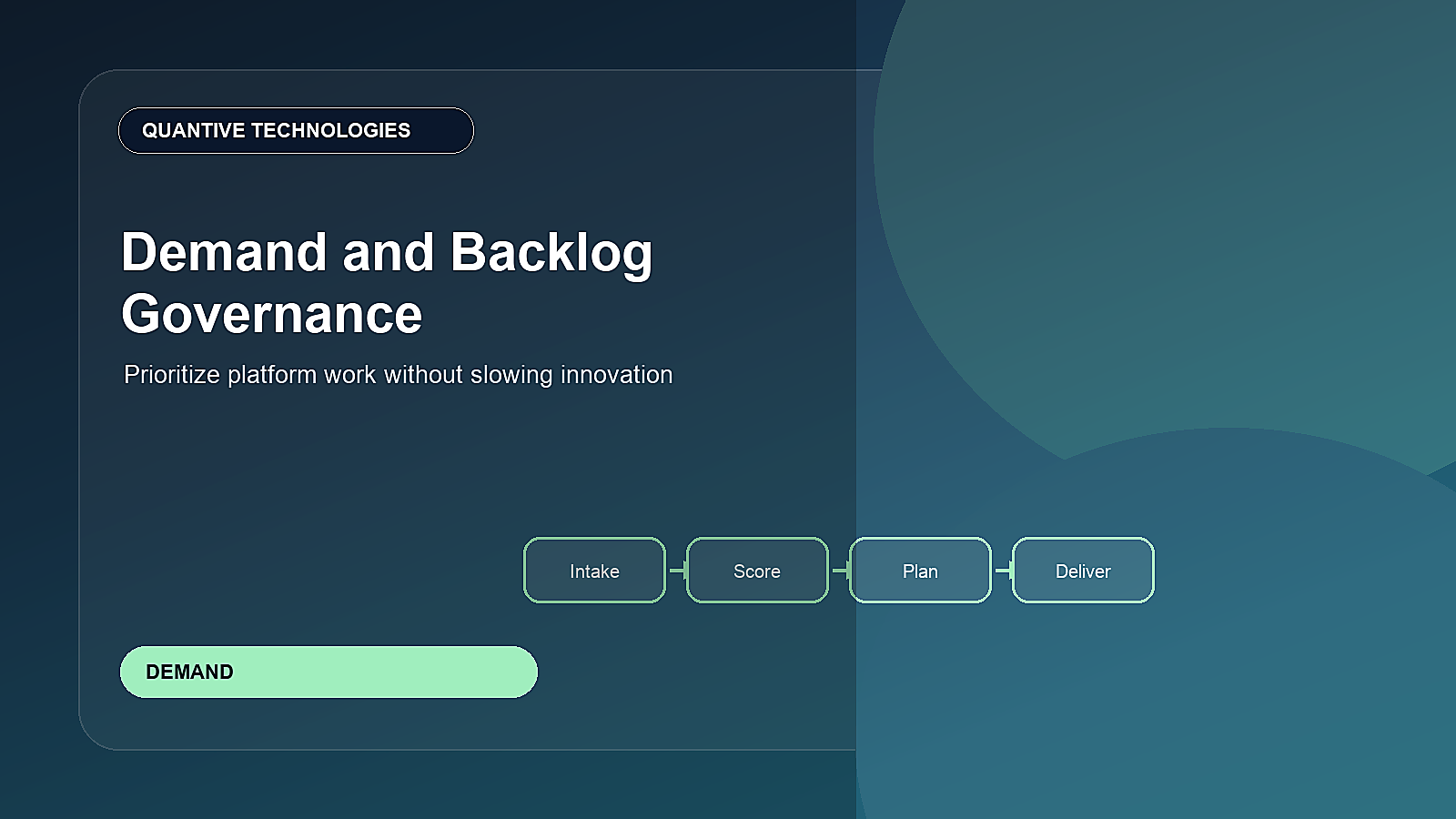
ServiceNow demand governance helps leaders decide which platform requests deserve attention, which should wait, and which should be declined before the backlog becomes unmanageable.
As ServiceNow adoption grows, every department discovers new ideas for automation, portals, workflows, dashboards, integrations, and AI assistance. That is a good sign, but without a clear intake and prioritization model, the platform team can become a ticket queue for competing business asks.
Article at a glance
Why this matters: ServiceNow governance now has to cover workflows, data, integrations, releases, AI, security, and measurable business value. Readers need a practical way to turn governance from policy into daily decisions.
How to apply this guidance
| Step | What to clarify |
|---|---|
| 1. Clarify ownership | Define who owns platform strategy, process decisions, data quality, release control, risk acceptance, and value tracking. |
| 2. Set usable standards | Publish standards for intake, catalog design, roles, integrations, reporting, AI use, and technical debt handling. |
| 3. Review health and value | Use recurring evidence-based reviews to connect platform health, backlog, adoption, risk, and measurable outcomes. |
Use the rest of the article as a planning checklist: confirm the target outcome, test the workflow and data assumptions, then connect governance, ownership, measurement, and adoption before expanding the use case.
Governed demand does not reject innovation. It creates a fair way to compare value, urgency, Risk Management, dependency, effort, and strategic fit so the roadmap reflects what matters most.
Why governance matters now
ServiceNow has become a platform for enterprise workflow, not only an IT tool. Business teams now expect faster delivery, cleaner experiences, and more automation. Platform teams need a way to protect capacity while still encouraging useful ideas.
AI use cases also increase demand. Teams may ask for AI agents, summaries, automation, and conversational experiences, but not every use case is ready. Demand governance helps evaluate whether the ServiceNow Data Integration, process, permissions, and controls are mature enough.
What good governance looks like
A healthy intake model gives requesters a simple way to describe the business problem, users affected, expected value, urgency, regulatory need, ServiceNow Data Integration requirements, and timing. The platform team then scores the request against shared criteria.
The backlog should be visible, but not chaotic. Separate strategic roadmap items, defects, compliance work, technical debt, small enhancements, and experiments. Each class of work needs its own prioritization rules.
Key governance areas
| Governance area | What to define | Why it matters |
|---|---|---|
| Intake criteria | Business outcome, user impact, compliance need, scope, data needs, and target date | Improves request quality before estimation starts |
| Scoring model | Value, risk, urgency, effort, dependency, and strategic alignment | Makes prioritization more transparent |
| Capacity planning | Team availability, release windows, platform health work, and operational support load | Prevents overcommitted roadmaps |
| Roadmap cadence | Monthly or quarterly reviews with process owners and sponsors | Keeps business stakeholders aligned |
| Backlog hygiene | Aging, duplicates, stale requests, blocked items, and technical debt visibility | Keeps the backlog actionable |
A practical demand governance model
- Create one intake path for new platform ideas, enhancements, automation, reporting, and integration requests.
- Define scoring rules that balance value, Risk Management, urgency, complexity, user impact, and technical readiness.
- Reserve delivery capacity for platform health, technical debt, security, upgrades, defects, and operational hygiene.
- Review the backlog with business stakeholders on a fixed cadence and publish roadmap decisions.
- Use Platform Care AI to identify platform health items that should compete for roadmap capacity alongside new feature work.
Common mistakes to avoid
- Letting the loudest stakeholder drive the roadmap.
- Treating all enhancement requests as equal.
- Ignoring technical debt until it blocks delivery.
- Approving work without confirming ServiceNow Data Integration, ownership, and support readiness.
- Building automations that solve a local request but create platform inconsistency.
Metrics leaders should monitor
- New demand by source, service area, value score, and request type.
- Backlog age, blocked items, duplicate requests, and stale demand.
- Roadmap capacity allocated to strategic work, defects, Risk Management, and platform health.
- Cycle time from intake to decision and decision to delivery.
- Delivered value, adoption, and requester satisfaction after release.
Where Platform Care AI helps
Platform Care AI can support governance by giving leaders a clearer view of platform health, Risk Management signals, technical debt, and improvement priorities between formal review cycles.
- Expose governance and platform-health priorities that may be invisible in a normal feature backlog.
- Support more balanced roadmap decisions by pairing business demand with health, Risk Management, and improvement signals.
- Help platform owners explain why some capacity must stay reserved for hygiene and resilience.
How this connects across ServiceNow
Demand governance should connect with Performance Analytics for value tracking, Risk Management for control work, ServiceNow Data Integration for integration readiness, and ServiceNow consulting services when the roadmap needs a broader operating-model reset.
Practical next step
Review the current ServiceNow backlog and tag each item as strategic, compliance, defect, technical debt, operational hygiene, reporting, or experiment. That simple classification often reveals whether the roadmap is balanced.
Quantive Technologies perspective
Quantive Technologies helps platform owners design ServiceNow intake models, prioritization criteria, roadmap cadence, and value dashboards. Platform Care AI can strengthen this model by keeping platform health and improvement signals visible during prioritization.
Need help turning this into a ServiceNow roadmap?
For more information or a focused implementation discussion, please reach out to info@quantivetech.com.