
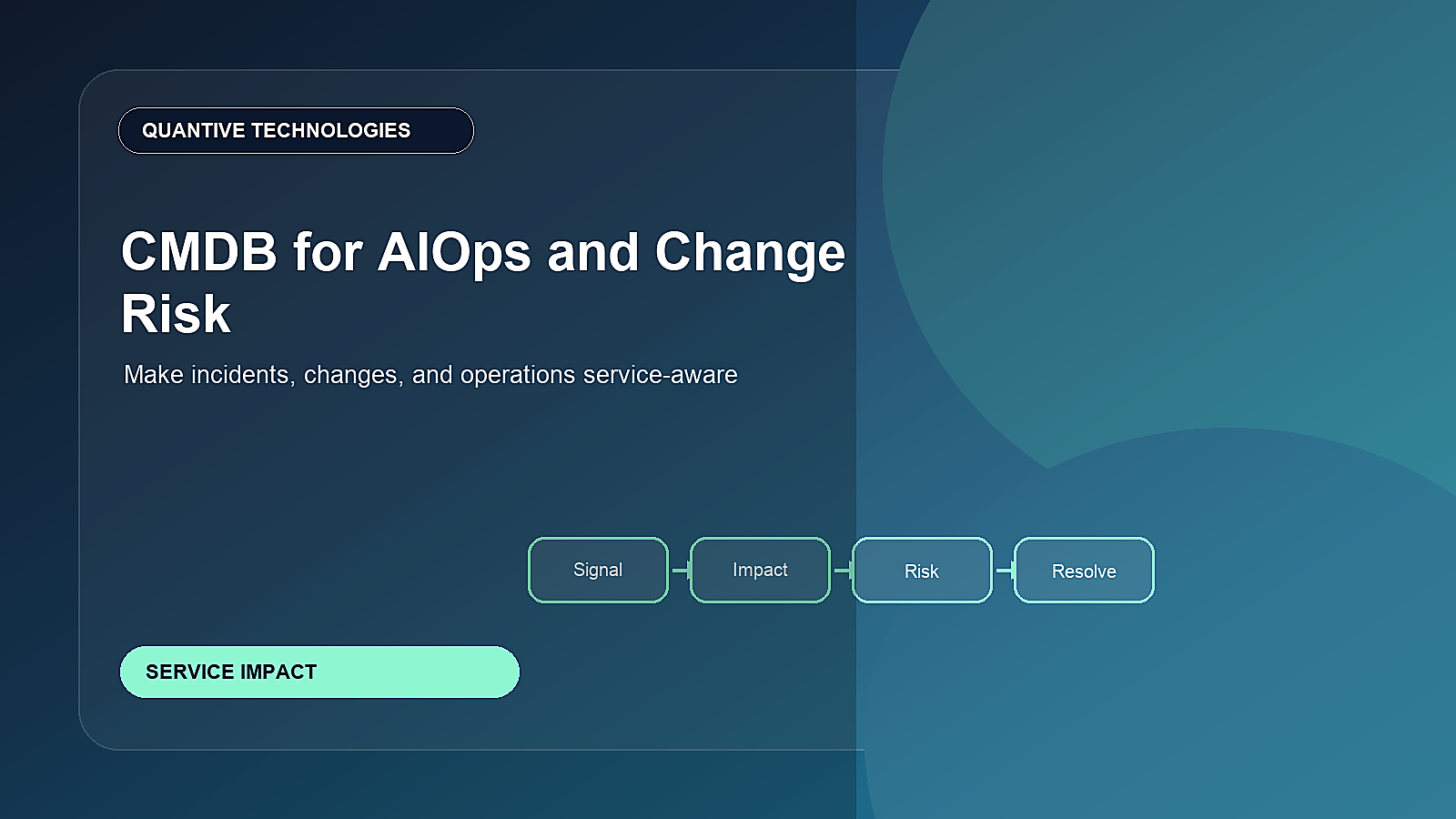
AIOps and change Risk Management management become much stronger when ServiceNow understands service relationships. CMDB and CSDM provide the context that turns technical signals into business-aware action.
Operations teams receive alerts, incidents, changes, maintenance windows, vulnerability signals, performance events, and user complaints. Without service context, each signal competes for attention. With CMDB and CSDM, teams can understand which services are impacted, which owners should respond, which recent changes may be related, and which work should be prioritized first.
Article at a glance
Why this matters: CMDB and CSDM work is the foundation for impact analysis, service operations, risk decisions, AI readiness, and executive reporting. Readers need practical guidance that connects data quality to business service outcomes.
How to apply this guidance
| Step | What to clarify |
|---|---|
| 1. Define the model | Clarify the service, application, infrastructure, owner, and dependency model before expanding data ingestion. |
| 2. Control sources | Decide which discovery, connector, integration, and manual sources are trusted for each data class. |
| 3. Measure health | Track completeness, correctness, relationship quality, freshness, ownership, and service coverage. |
Use the rest of the article as a planning checklist: confirm the target outcome, test the workflow and data assumptions, then connect governance, ownership, measurement, and adoption before expanding the use case.
This is where CMDB moves beyond inventory. It becomes an operational intelligence layer for AIOps, incident triage, major incident management, change advisory decisions, and executive service health reporting.
Why this is trending now
The market is moving toward proactive, AI-assisted operations. Leaders want fewer outages, faster resolution, safer releases, and less alert noise. These goals depend on connecting technology events to service impact and change history.
At the same time, release velocity is increasing. More frequent changes create more pressure on Risk Management review. A service-aware CMDB helps teams evaluate whether a change touches critical services, unstable components, recent incident areas, or high-Risk Management dependencies.
Beginner-friendly explanation
AIOps is often described as using AI and analytics to improve IT operations. In practical terms, it helps teams reduce noise, correlate events, identify likely causes, predict impact, and recommend action. But AIOps needs a map. CMDB and CSDM provide that map.
Change Risk Management works similarly. A change record by itself may describe what a team plans to do. A CMDB-connected change can show which CIs and services are touched, who owns them, whether similar changes caused incidents, and what business impact is possible.
Core concepts to understand
| Concept | What it means | Why it matters |
|---|---|---|
| Service impact | The business or user-facing effect of a technical issue | Helps teams prioritize the right work first |
| Event correlation | Grouping related alerts or events into a more meaningful signal | Reduces noise and speeds triage |
| Change risk | The likelihood and impact of disruption from a proposed change | Improves approval quality and release confidence |
| Dependency map | Relationships showing what a service depends on | Supports root cause and blast radius analysis |
| Operational resilience | The ability to keep services stable and recover quickly | Links service data to business continuity outcomes |
A service-aware operating model
A service-aware operating model connects monitoring, alerts, incidents, changes, application services, business services, owners, and support groups. This does not require every dependency on day one. It requires enough trusted context around priority services to improve decisions.
Start by choosing services where downtime is expensive, change volume is high, or alert noise is painful. Build relationships around those services, connect operational signals, and measure whether teams can triage and approve work faster with better confidence.
- Map critical business services to application services, owners, support groups, and core dependencies.
- Connect monitoring or event signals to the right CIs and services.
- Use recent incidents, known errors, dependency criticality, and service importance in change Risk Management review.
- Give major incident teams a service impact view rather than only technical alert lists.
- Use Performance Analytics dashboards to track outage reduction, change success, and mean time to resolve.
Practical implementation roadmap
- Select high-impact services where AIOps or change Risk Management improvements would create visible value.
- Validate CI and service relationships for those services before adding more alert sources.
- Connect event, incident, problem, and change records to CIs and services consistently.
- Define Risk Management scoring criteria that use service criticality, recent incidents, dependency type, and implementation timing.
- Review outcomes after each major incident or failed change and improve the model.
Common mistakes to avoid
- Buying AIOps tooling before the service model is trustworthy enough to support it.
- Routing alerts only by device or technology team instead of service impact.
- Reviewing change Risk Management without checking service dependencies or recent incidents.
- Mapping too much low-value infrastructure while critical applications remain unclear.
- Failing to use post-incident learning to improve CMDB relationships and Risk Management rules.
Metrics leaders should track
- Mean time to detect, acknowledge, and resolve incidents for modeled services.
- Event noise reduction and correlated alert rate.
- Changes linked to valid CIs and services.
- Change success rate for critical services.
- Major incidents with clear service impact, owner, and dependency context.
How this connects across ServiceNow
CMDB for AIOps and change Risk Management connects ServiceNow IT Operations Management, ServiceNow IT Service Management, Risk Management, and Performance Analytics. ITOM provides operational signals. ITSM manages incidents and changes. Risk practices help evaluate exposure. Analytics shows whether the service-aware model is actually reducing disruption.
90-day action plan
- Days 1-30: choose three critical services and validate their CIs, owners, support groups, dependencies, and recent incident history.
- Days 31-60: connect event, incident, and change workflows to those services and define service-aware Risk Management signals.
- Days 61-90: run operational reviews using the new service view and measure triage speed, change outcomes, and alert noise reduction.
Quantive Technologies perspective
Quantive Technologies helps operations leaders make CMDB and CSDM useful in live work. We connect service relationships with ServiceNow IT Operations Management, incident and change workflows in ServiceNow IT Service Management, Risk Management controls through Risk Management, and dashboards in Performance Analytics so AIOps and change Risk Management decisions are grounded in trusted service context.
Need help turning this into a ServiceNow roadmap?
For more information or a focused implementation discussion, please reach out to info@quantivetech.com.