
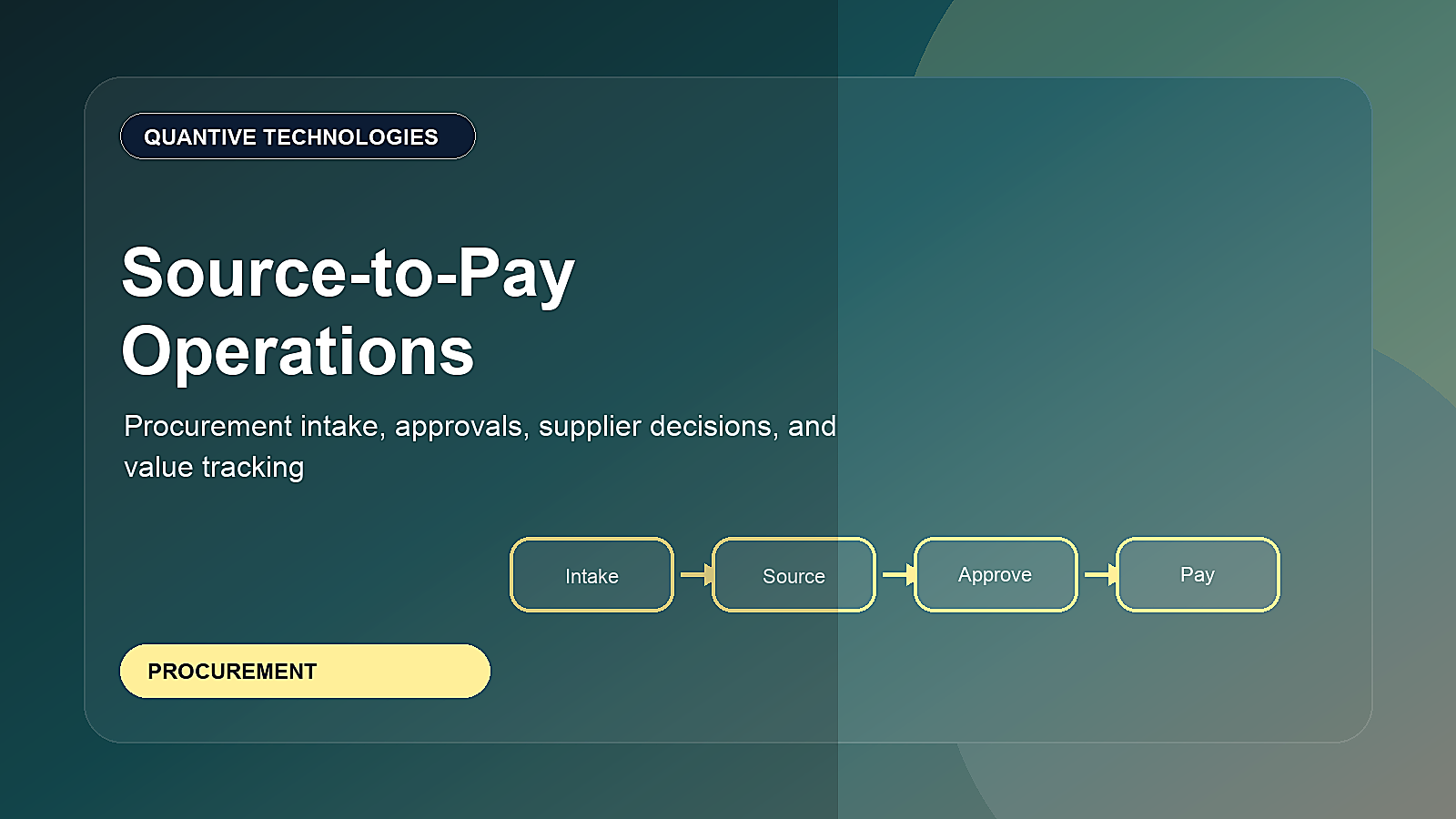
Source-to-pay transformation is not only about procurement technology. It is about how requests become decisions, suppliers become partners, and spending becomes visible. ServiceNow Sourcing and Procurement Operations helps organizations modernize procurement workflows so employees, buyers, approvers, and suppliers can move through the process with less friction.
Many organizations still manage procurement through email, spreadsheets, disconnected portals, and manual approvals. The cost is not just slow cycle time. It is poor spend visibility, inconsistent policy enforcement, supplier delays, and a frustrating experience for business users.
Article at a glance
Why this matters: ServiceNow describes Sourcing and Procurement Operations as a single engagement layer across systems for indirect procurement. The content should help readers connect intake, policy, supplier data, approvals, ERP integration, and measurable outcomes. In this article, the practical focus is turning procurement intake into measurable source-to-pay value.
How to apply this guidance
| Step | What to clarify |
|---|---|
| 1. Unify intake | Replace fragmented email and spreadsheet work with guided request paths that capture purpose, spend, category, and urgency. |
| 2. Connect policy and supplier data | Use approved suppliers, catalogs, cost centers, contracts, and ERP records so routing and approvals stay reliable. |
| 3. Improve continuously | Measure request cycle time, compliance, savings, supplier responsiveness, requester effort, and exception patterns. |
Use the rest of the article as a planning checklist: first confirm the business outcome, then test the workflow, data, ownership, integration, governance, and measurement assumptions before expanding the use case.
What source-to-pay means in practical terms
Source-to-pay covers the journey from business need to supplier decision, purchase approval, fulfillment, and payment handoff. In many companies, these steps live in different systems and teams. ServiceNow can provide a workflow layer that connects intake, sourcing, approvals, supplier engagement, and status visibility.
Where ServiceNow can create value
- Procurement intake: Give employees a guided place to submit requests and provide required details.
- Request triage: Prioritize requests by spend, urgency, category, risk, and completeness.
- Approvals: Route financial, legal, security, and business approvals through structured workflows.
- Supplier collaboration: Improve communication and status tracking with vendors.
- Analytics: Track cycle time, backlog, savings, compliance, and supplier performance.
The hidden value of procurement intake
Procurement transformation often starts too late in the process. By the time procurement sees a request, the business may already have selected a vendor, negotiated informally, or created urgency that limits sourcing options. A strong intake process brings procurement into the conversation earlier, with enough information to guide the right path.
| Procurement moment | Common issue | Workflow improvement |
|---|---|---|
| Request intake | Incomplete business justification | Guided forms and required fields by category |
| Supplier selection | Limited visibility into approved vendors | Preferred supplier guidance and risk checks |
| Approvals | Email-based delays | Automated routing and escalation |
| Status updates | Requesters ask procurement for updates | Self-service status and notifications |
| Spend tracking | Hard to connect request to outcome | Workflow records tied to analytics |
Where AI can help source-to-pay
AI can make procurement workflows more intuitive by classifying requests, identifying missing information, recommending categories, summarizing supplier history, drafting buyer communications, and surfacing risks. The key is to keep AI connected to policy, supplier data, contract context, and approval guardrails.
Implementation priorities
1. Define intake categories
Start with the top request categories by volume and spend. Each category should have a clear data model, routing rule, approval path, and service-level expectation.
2. Build approval logic around risk
Not every request needs the same review. Create tiered workflows for low-value purchases, strategic sourcing, regulated vendors, security-sensitive purchases, and contract exceptions.
3. Connect supplier and contract context
Procurement teams need to see whether a supplier is approved, whether risk reviews are current, whether contracts exist, and whether prior performance issues should influence the decision.
4. Measure business outcomes
Track request cycle time, buyer workload, supplier response time, approval delays, savings opportunities, policy compliance, and requester satisfaction.
Integration considerations
Source-to-pay usually spans multiple systems. ERP may hold purchase orders and payments. Contract lifecycle tools may hold agreements. Supplier systems may hold onboarding details. Finance systems may hold budgets. ServiceNow does not need to replace all of these systems to create value. It can orchestrate the work across them and provide a clearer experience for business users.
Integration planning should focus on the records that matter most: suppliers, categories, budgets, contracts, purchase requests, approvals, purchase orders, invoices, and risk status. If those records are connected with appropriate controls, procurement teams can make faster decisions without losing governance.
What an effective source-to-pay dashboard should show
- Open procurement requests by category, value, priority, and owner
- Requests blocked by missing information or pending approvals
- Average cycle time by request type
- Supplier response time and onboarding status
- Potential savings, avoided spend, or policy compliance opportunities
- High-risk suppliers or requests requiring special review
What to watch in ServiceNow’s procurement roadmap
ServiceNow’s recent product direction points toward AI-supported work and better cross-enterprise control. For procurement, that creates opportunities to use AI for intake classification, buyer assistance, policy guidance, supplier communication, and request summarization. The value will be highest when AI is connected to accurate procurement data and transparent approval workflows.
Quantive Technologies perspective
Source-to-pay improvement works best when procurement, finance, legal, risk, IT, and business teams share one operating model. Quantive Technologies can help design ServiceNow intake workflows, connect supplier and contract data, automate approvals, and build analytics that show where procurement creates measurable value.
This work connects naturally with ServiceNow Data Integration, Risk Management, and Performance Analytics.
Need help turning this into a ServiceNow roadmap?
For more information or a focused implementation discussion, please reach out to info@quantivetech.com.