
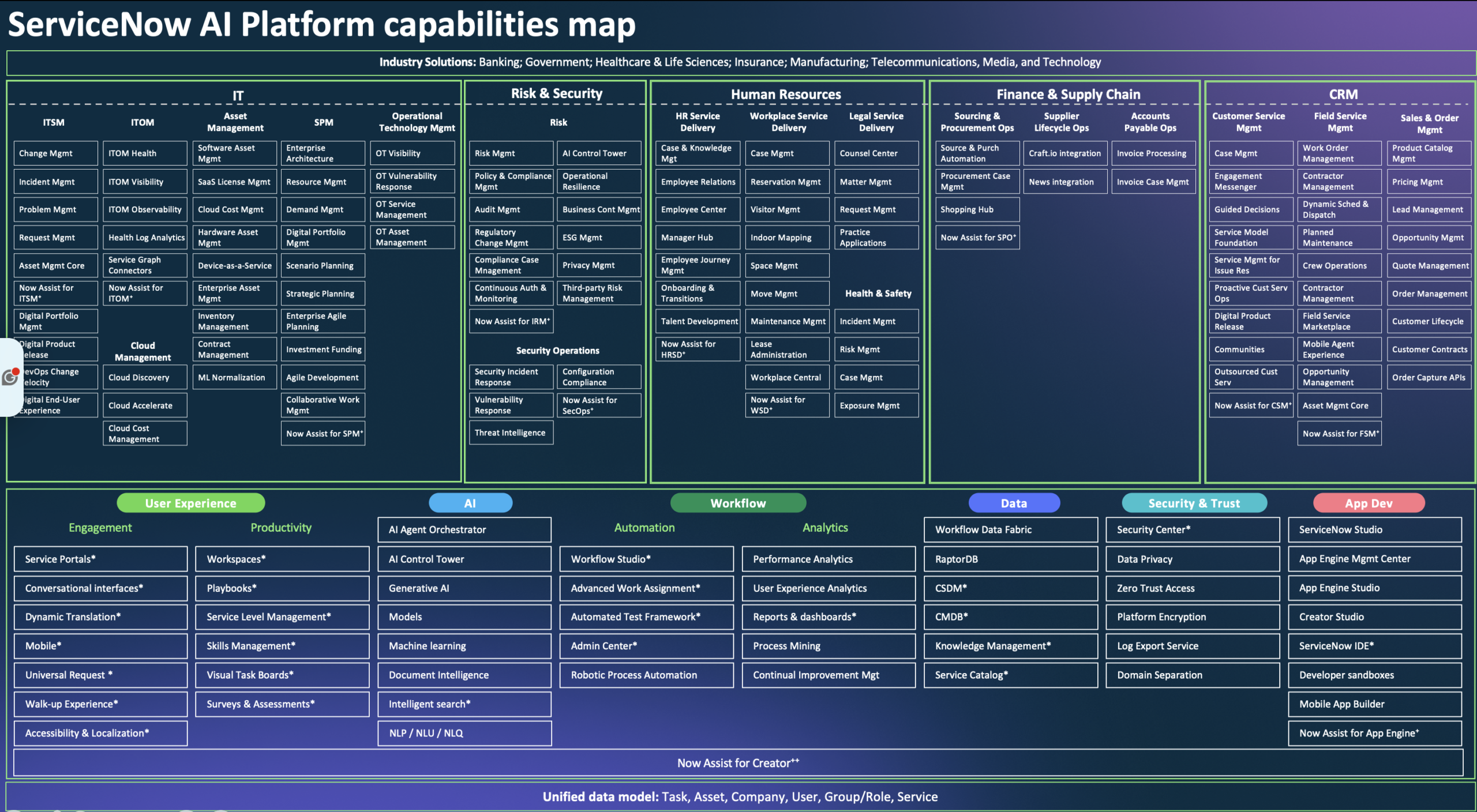
In the modern enterprise, work happens everywhere – IT teams resolving incidents, HR onboarding employees, customer service handling cases, and operations teams keeping digital services running around the clock. Yet in many organizations, this work is slowed by manual processes, disconnected systems, and departmental silos.
ServiceNow was built to solve this problem
At its core, ServiceNow is a cloud-native enterprise workflow automation and digital transformation platform. It unifies people, processes, and systems on a single platform, enabling organizations to automate work end to end and operate with greater speed, transparency, and intelligence.
Rather than forcing teams to work across disconnected tools, ServiceNow provides one system where work flows consistently across the business.
The Technical Core of the ServiceNow Platform
-
Unified Platform Architecture
ServiceNow runs on a single, scalable cloud platform where applications share a common data model and platform services. This unified architecture eliminates data silos and enables consistent visibility across departments.
Because workflows, data, and integrations all reside on the same platform, organizations can connect processes across IT, HR, customer service, security, and operations without complex point-to-point integrations.
-
Workflow Automation and Orchestration
At a technical level, ServiceNow is powered by a workflow engine that orchestrates tasks, approvals, conditions, and notifications.
These workflows:
- Standardize how work is executed
- Reduce manual handoffs and delays
- Ensure consistency across teams and regions
From incident resolution in IT to case handling in customer service, ServiceNow workflows ensure work progresses predictably and efficiently.
-
Embedded Artificial Intelligence (AI)
ServiceNow embeds AI directly into workflows rather than treating it as a standalone capability. This includes:
- Predictive intelligence for classification and routing
- AIOps capabilities for anomaly detection and event correlation
- AI-assisted recommendations that guide users and agents
By integrating AI into operational processes, ServiceNow helps organizations not only automate work, but continuously optimize how work is done.
-
Low-Code Development and Extensibility
ServiceNow enables both technical and non-technical users to extend the platform using low-code tools such as App Engine Studio.
These capabilities allow organizations to:
- Build custom applications quickly
- Extend existing workflows without heavy custom coding
- Adapt the platform as business needs evolve
This approach supports rapid innovation while maintaining platform governance and consistency.
Core Capabilities and Product Areas :
ServiceNow’s platform is modular and designed to support multiple business functions through integrated automation.
IT and Digital Operations
Supports capabilities such as IT Service Management (ITSM), IT Operations Management (ITOM), and IT Asset Management (ITAM), helping organizations deliver resilient and reliable digital services.
Application Development
Enables teams to build, deploy, and manage custom enterprise applications using low-code development and reusable workflow components.
Enterprise Workflow Automation
Automates processes that span departments – including HR, finance, security, and customer service – creating a connected operating model across the organization.
These product areas are reinforced by platform capabilities such as AIOps, AI-driven assistance, service-aware data models, and enterprise-grade security and governance.
Industry-Specific Use Cases :
Different industries face different operational challenges, and ServiceNow addresses this through industry-aligned solutions built on the same core platform.
Examples include:
- Healthcare: Streamlining care coordination and administrative workflows
- Banking and Financial Services: Supporting risk-aware digital operations and regulatory compliance
- Manufacturing: Improving asset visibility and operational resilience
- Retail and Consumer Goods: Enhancing customer experience and supply chain workflows
- Government: Delivering secure, citizen-focused digital services
These solutions combine ServiceNow’s workflow automation with industry best practices to accelerate digital transformation.
ServiceNow vs. Other Enterprise Platforms
Unlike platforms designed for a single function, ServiceNow is fundamentally workflow-centric, connecting processes across the enterprise.
Platform Focus |
Typical Capability |
ServiceNow Advantage |
| ITSM Tools | IT ticketing and support | Enterprise-wide workflow automation |
| Traditional CRM | Sales and customer support | AI-driven workflows across departments |
| ERP Systems | Finance and operations | Cross-functional automation beyond back office |
| Standalone AI Tools | Analytics and predictions | Governance and action embedded in workflows |
ServiceNow can support ITSM, CRM-like use cases, security operations, and custom enterprise applications – but its true value lies in connecting these capabilities into a single system of work.
Why Organizations Adopt ServiceNow :
Organizations choose ServiceNow to:
- Eliminate manual and repetitive work
- Break down operational silos
- Gain real-time visibility into services and processes
- Scale securely on a unified platform
- Deliver better employee and customer experiences
The result is faster service delivery, higher productivity, and a digital foundation that supports long-term growth and innovation.
Ready to Transform Your Workflows?
Ready to elevate your business with smarter, scalable technology? At Quantive Technologies, we turn ideas into impactful solutions.
Let’s start the conversation—reach out to us at info@quantivetech.com.