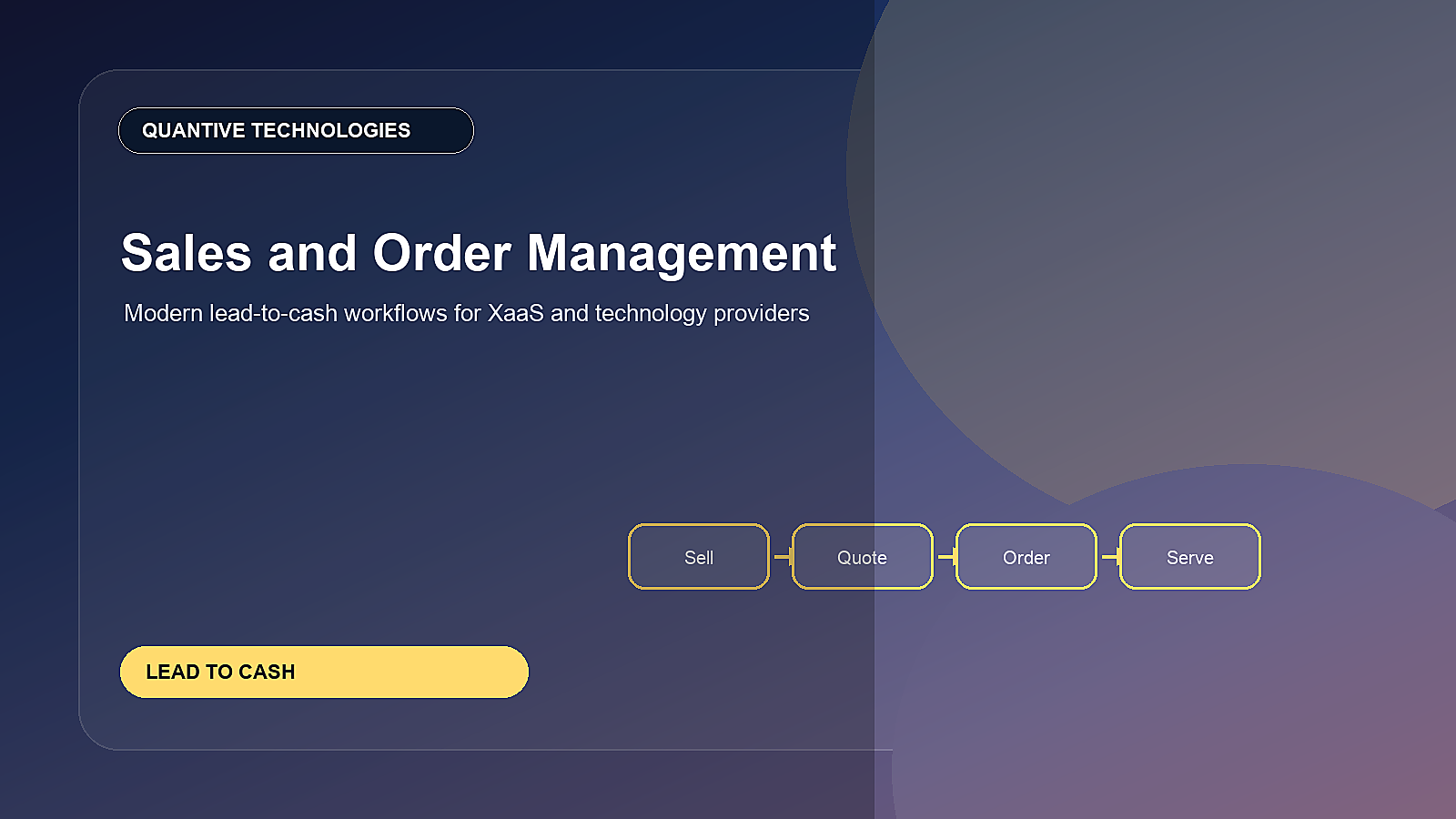
For XaaS and technology providers, lead-to-cash is no longer a simple path from opportunity to invoice. Customers expect fast quotes, accurate orders, clear onboarding, usage-aware service, and proactive communication. Internally, sales, CPQ, legal, finance, fulfillment, product, operations, and customer service all need to move together.
ServiceNow Sales and Order Management is designed for this type of connected operating model. It helps organizations accelerate the lead-to-cash cycle, improve order visibility, and reduce manual handoffs across customer-facing and back-office teams.
Article at a glance
Why this matters: Technology providers sell recurring, bundled, usage-based, and service-heavy offerings. The customer experience depends on what happens after the opportunity, not only what happens inside CRM.
How to apply this guidance
| Step | What to clarify |
|---|---|
| 1. Map lead-to-cash | Document the full path from opportunity to quote, order booking, fulfillment, billing handoff, and customer service visibility. |
| 2. Find handoff risk | Identify where teams re-enter data, wait for approvals, lose customer context, or manage exceptions by email. |
| 3. Orchestrate work | Use ServiceNow workflows to govern approvals, tasks, status, ownership, and customer communication across systems. |
Why XaaS lead-to-cash is hard
XaaS businesses often sell subscriptions, bundles, professional services, consumption-based offerings, renewals, upgrades, and customer-specific entitlements. A closed opportunity may trigger pricing approvals, contract changes, product configuration, onboarding tasks, provisioning, support setup, billing handoffs, and customer success follow-up.
When those steps live in disconnected systems, the business sees friction: quote rework, order errors, slow fulfillment, duplicate data entry, poor status visibility, and confused customers. CRM may show the opportunity is won, but the customer experience is still at risk.
Where Sales and Order Management fits
ServiceNow does not need to replace every sales or finance system to add value. In many architectures, CRM remains the opportunity source, CPQ supports product and pricing logic, ERP manages financial records, and ServiceNow orchestrates the work between teams. The platform becomes the workflow layer that turns commercial intent into operational execution.
| Stage | Typical challenge | ServiceNow workflow opportunity |
|---|---|---|
| CRM opportunity | Sales context does not reach delivery and service teams | Capture structured handoff data and customer commitments |
| CPQ and approvals | Exceptions move through email or informal review | Route pricing, legal, risk, and product approvals with clear ownership |
| Order capture | Missing data creates booking delays and downstream rework | Validate order details before fulfillment starts |
| Fulfillment | Multiple teams execute without one visible work plan | Orchestrate tasks, dependencies, milestones, and status updates |
| Customer experience | Support teams cannot see what was promised or ordered | Connect case teams to order, entitlement, and fulfillment context |
Customer experience is the real test
A customer does not care whether the delay happened in CRM, CPQ, ERP, billing, implementation, or support. They experience one company. That is why lead-to-cash modernization should be measured from the customer’s point of view. How long did it take to receive an accurate quote? How many times did the customer repeat information? Did onboarding start on time? Could the service team see order status? Were expectations met?
ServiceNow can help by giving each team the right task, context, and status visibility. That reduces internal chasing and helps customer-facing teams communicate with confidence.
AI opportunities in lead-to-cash
AI can support lead-to-cash when it is grounded in trusted workflow data. Useful examples include summarizing opportunity context, highlighting missing order details, recommending approval paths, drafting customer updates, detecting fulfillment risk, and giving service teams a concise view of what was sold and promised.
The important guardrail is that AI should not make uncontrolled commercial commitments. For pricing, contract, entitlement, and compliance-sensitive work, AI should assist the workflow while human approval remains in place where needed.
Implementation roadmap
- Map the current journey: Document every handoff from opportunity to quote, order, fulfillment, billing, onboarding, and support.
- Prioritize friction points: Start with the delays that most affect revenue recognition, order quality, or customer satisfaction.
- Define the system of action: Decide which work should be orchestrated in ServiceNow and which systems remain records of truth.
- Standardize order data: Make required details, dependencies, customer commitments, and exception rules visible.
- Measure before and after: Track quote cycle time, order accuracy, fulfillment time, rework, escalations, and customer status inquiries.
Questions leaders should ask
- Where do quote approvals slow down the most?
- How often are orders corrected after booking?
- Which teams need visibility before customer fulfillment can start?
- Can customer service see order commitments without asking sales?
- Which AI use cases would reduce manual research without weakening controls?
Quantive Technologies perspective
Quantive Technologies sees Sales and Order Management as a strong fit for organizations that need more than pipeline tracking. XaaS and technology providers need workflow control after the deal moves forward. Connecting Customer Service Management, data integration, and Performance Analytics can help teams modernize lead-to-cash with measurable improvements in speed, quality, and experience.
ServiceNow describes Sales and Order Management as a way to accelerate the lead-to-cash cycle and improve customer experience. The product overview is available on the ServiceNow Sales and Order Management page.
Need help turning this into a ServiceNow roadmap?
For more information or a focused implementation discussion, please reach out to info@quantivetech.com or book your discovery call.